
Nature’s Own Remedies: Exploring Fractals and Phytoncides for Well-being
Discover the fascinating effects of fractals and phytoncides on our mental and physical health. Uncover the calming influence of fractal patterns and the immune-boosting properties of phytoncides found in nature. Explore our SFTA Hypnotherapy Training course to learn more about incorporating nature-based therapies into your practice.
Nature holds remarkable secrets that contribute to our well-being. In this article, we explore the world of fractals and phytoncides, shedding light on their influence on our mental and physical health. Discover the synergy between nature and therapy in Solution Focused Walking Therapy.
Have you ever wondered why you feel better after walking in the park or feel happier pottering around the garden?
You might blame it on the fresh air, enjoying being out in nature. But there is more to it than that, a lot more ….
It’s all to do with fractals and phytoncides….
What are fractals?
Fractals are repeating patterns abundantly found in nature, exhibiting infinite complexity. Explore how objects like ferns, seashells, and trees display fractal patterns, providing a glimpse into the inherent order and harmony of the natural world. Discover how exposure to fractal patterns can reduce stress levels and create a calming effect.
The beauty of fractals
The closer you look at a fractal, the more interesting it becomes. Think about a fern with its fonds and branches. Take a closer look; you will see the branches coming out from the main stem. Each of those branches looks similar to the fond itself: a nautilus shell or the delicate symmetry of a snowflake. Fractals offer a glimpse into the inherent order and harmony present in the natural world. They are not limited to nature alone; they are generated through mathematical algorithms or created by digital artworks that stimulate and inspire us.
What happens when you look at a fractals
We have hard wiring in our brains that respond to certain natural fractals. The results of many studies show that exposure to fractal patterns reduces people’s stress levels by up to 60%. This stress reduction effect seems to occur because of a certain physiological resonance within the eye. You may have been in a doctor’s or dentist’s office with a scenic mural of some aspect of nature on the wall. Bringing nature and those repetitive patterns indoors can have a calming effect on patients.
So how can you use fractals to feel happier?
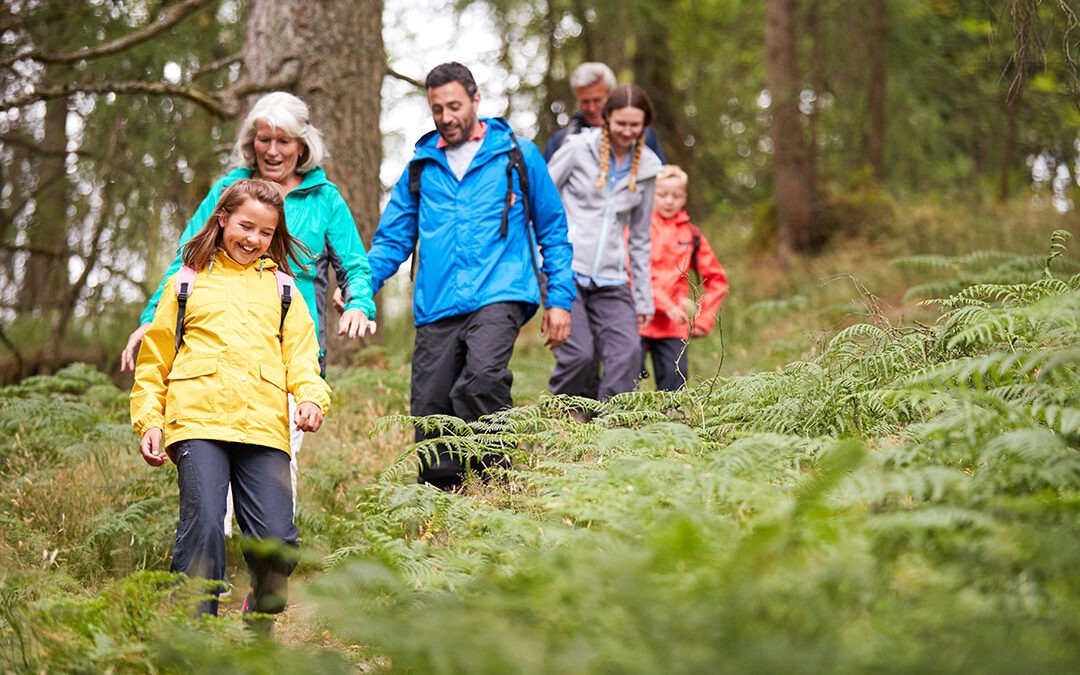
Take a walk in nature, go to a park, visit a garden, yours or someone else’s, sit and watch the clouds for a while and notice the patterns. Or you can do what children often find pleasing; get a bottle of bubbles and blow bubbles outside. Why not set your screensaver or wallpaper to a fractal image?
Experiment for yourself and deliberately place yourself in one of those fractal rich environments for about 20 minutes daily for a week. Notice your stress level before and after each episode. See how you can use fractals to bring calmness and relaxation to your day.
Phytoncides – the reason to be in nature
Do you choose to go for a woodland walk to remedy stress? Have you ever wondered why this happens?
Well, scientists are unveiling the secrets of this phenomenon. They have been working on this subject for some time and have made wonderful discoveries!
Some particles in the air can have amazing effects on our mental and physical health. These spectacular molecules are called phytoncides.
What are phytoncides?
Phytoncides are volatile organic compounds emitted by plants and trees to defend against pathogens and pests. This means they evaporate easily and release large numbers of molecules into the surroundings at room temperature.
These compounds are responsible for the distinctive and refreshing scents often associated with forests, mountains, and other natural environments. The musty, earthy odour of the forest, the aroma of pine trees, or the smell of the fresh, pure flowing water.
When we spend time in these areas, we inhale these phytoncides, and they interact with our bodies to provide various health benefits, including anxiety reduction.
Where can you find phytoncides?
All plants produce some phytoncides, from the wild garlic in the forest to the trees in your garden or the chilli plants on your windowsill. Of course, the most concentrated amounts of phytoncides are in areas with the densest plant coverage – woods, jungles, botanical gardens… You get the idea?
What are the effects of phytoncides?
Being exposed to phytoncides in the air can greatly help your immune system.
The most researched path of improving the immune system is through the induction of Natural Killer cell activation. This path helps bodies more effectively kill tumours or virus-infected cells.
Interestingly, the effect of the heightened activity of NK cells is available for up to 30 days after a couple of hours walk in a forest. Scientists also found out that these volatile molecules decrease the concentrations of adrenaline. We destress!
There isn’t that much information about phytoncide’s effects on our bodies. But the available data makes us believe they are another reason to surround ourselves with plants. Going for a hike through the woods, growing plants inside our homes, or simply sitting on a bench in a park.
Nature is giving us amazing natural remedies that some of us seek intuitively. So, now it’s a great time to go out and embrace those fractals and phytoncides.
We have even combined therapy with a gentle stroll. This we call Solution Focused Walking Therapy.
I hope you found this interesting and inspiring. Start to lower those anxiety levels by taking control – and strolling!
Explore our SFTA Hypnotherapy Training course to expand your skills and incorporate the therapeutic potential of nature into your practice.